
A manufacturer's public record is worth reading, but not every line of it carries the same weight. Registrations, certificate scopes and dated records can be checked; capability claims can be tested with a single question; scale claims are usually company-reported and should be labelled as such. The discipline is to sort what you read into those three piles before any of it is allowed to shape a shortlist.
Key takeaways
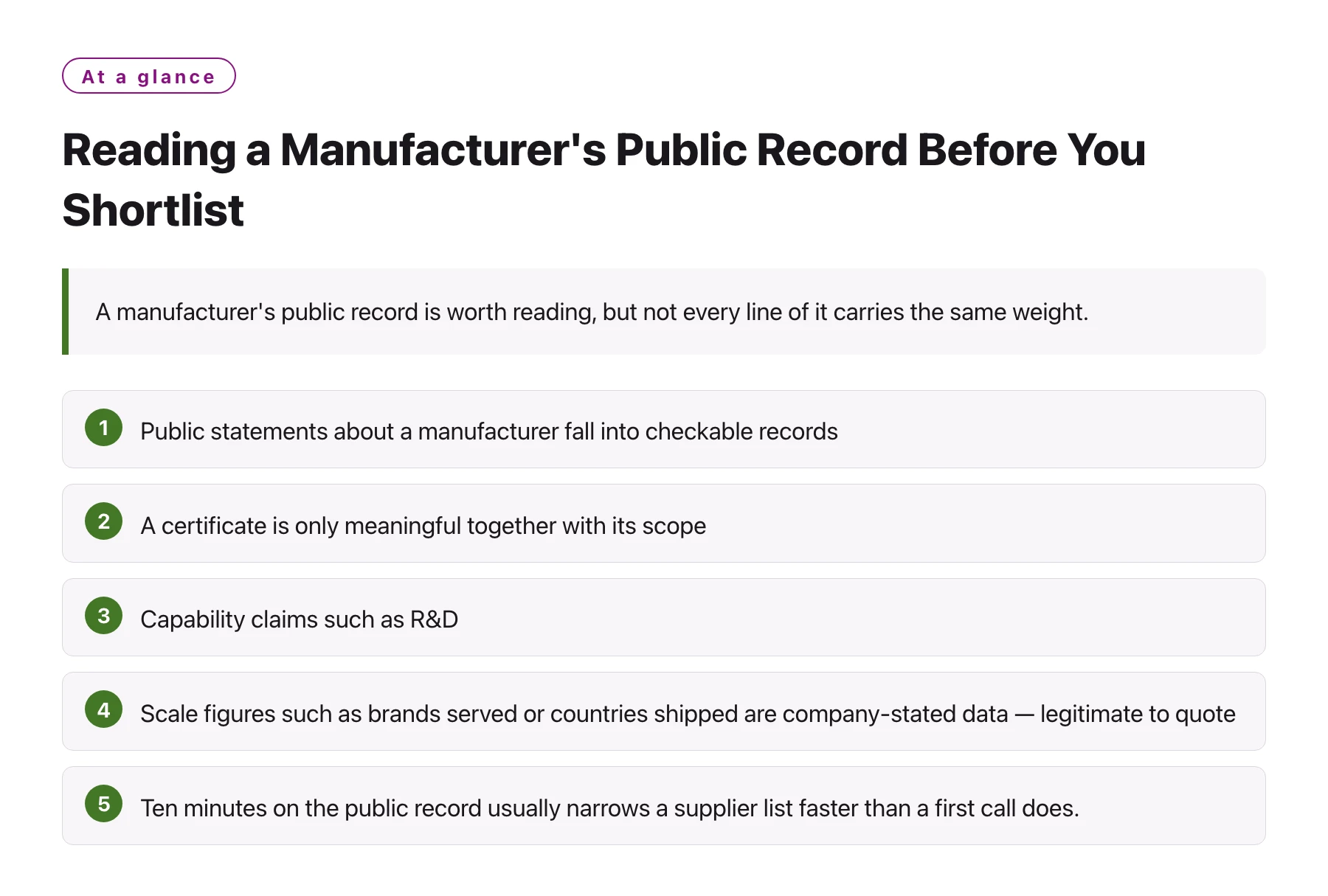
- Public statements about a manufacturer fall into checkable records, testable claims and company-reported figures, and only the first two should drive a shortlist.
- A certificate is only meaningful together with its scope, its issuing body and its expiry date.
- Capability claims such as R&D, filling or packaging design have to be traced to whether the work happens in-house or is subcontracted.
- Scale figures such as brands served or countries shipped are company-stated data — legitimate to quote, but not proof of fit.
- Ten minutes on the public record usually narrows a supplier list faster than a first call does.
Procurement teams tend to read supplier websites the way they read marketing, which is to say quickly and for tone. That is a waste, because a public record is the cheapest evidence available and it is available before anyone spends time on a call.
The problem is not the quantity of claims but the mixture. A single page can hold a registration number, a certificate logo, an in-house capability claim and a customer count, and those four things are not the same kind of statement.
Four kinds of statement, and what settles each one
| Statement you read | What would settle it | Where it normally comes from |
|---|---|---|
| Registered name and address | A dated company registration entry | The national business registry or a filed annual return |
| Years in the industry | A founding date that matches the registration | Registration records, early trade listings, archived pages |
| ISO 22716 or ISO 9001 | A certificate with a scope line, an issuing body and an expiry date | The certification body itself, not a logo on a page |
| R&D and filling in-house | A description of which steps happen on which site | A direct question about subcontracted steps and their control |
| Standards compliance | A category statement covering your exact product type | The published standards library the industry works to |
| Test capability | Named tests, named laboratories and report release terms | Third-party testing providers and your own verification |
The table is a reading method, not a checklist to send. Its purpose is to stop a certificate logo and a customer count from being treated as the same evidence.
Where the sorting actually bites
Most supplier evaluations go wrong in one of two directions. Either the buyer accepts everything on the page and later discovers that the filling step is subcontracted, or the buyer dismisses everything and ends up asking questions the public record had already answered, which wastes the supplier's patience as well as the buyer's calendar.
Reading a certificate properly
Quality and GMP certificates are issued against a defined scope, and the scope line is the part worth reading. A certificate for cosmetics good manufacturing practice covers a site and a set of activities, not the whole company and every product it touches, which is why the issuing body and the expiry date belong in the same sentence as the claim [1]. If the scope does not name the activity you are buying, ask for the annex rather than the certificate.
Testing the standards claim
Fragrance materials are managed through published restrictions that apply by product category, and industry bodies maintain the reference material most suppliers work from [2]. A useful question is not whether a supplier follows the standards — most say yes — but which category statement it would issue for your specific format, and who signs it.
Verifying test capability
Where testing is described, ask which laboratory runs it, under whose account, and whether results are released to the buyer. Independent laboratories publish the range of services they offer, which makes it easy to check that a claimed test is something the named provider can actually perform [3].
Public record, then case material
Once the claims are sorted, the second document set is the case material: the projects a manufacturer is willing to describe in enough detail to be useful. A supplier that can walk through examples of fragrance projects with formats, constraints and outcomes is showing you a process, not a highlight reel. What to look for is the constraint — the awkward market, the tight deadline, the material that had to be replaced — because that is the part with transfer value.
A manufacturer with a long history usually publishes some version of its background and certifications on its own site, and that page is a good place to check whether the claims are dated, sourced and consistent with everything else you have read. The company's own summary is a starting point for questions, never an answer.
A ten-minute routine before the first call
Read the registration entry, note the founding year, list every certificate with its scope and expiry, separate capability claims from scale claims, and mark anything that cannot be checked either way. Then write the three questions the page did not answer. That short routine converts a first supplier call from a presentation into an interrogation of the gaps, and the gaps are where a project either gets safer or gets abandoned early.
If you want a structured version of the same exercise, the discipline behind due diligence on a perfume manufacturer is worth copying: write down what you would accept as evidence before you look at the evidence, so the decision rule is fixed in advance.
One rule that saves arguments later: if a claim cannot be attached to a document, a date or a named person, write it in the notes as company-stated and move on. It is not a lie and it is not evidence — it is a question you have not asked yet.
Sources
- ISO 22716 — Cosmetics Good Manufacturing Practices
- International Fragrance Association (IFRA) —— IFRA is the global trade association of the fragrance industry; its site publishes the IFRA Standards, positions and science on the safe use of fragrance materials.
- SGS: Cosmetics, Personal Care & Household Testing —— Testing, inspection and certification services for cosmetics and personal care, including microbiological, stability and safety testing aligned with cosmetics GMP.
Frequently asked questions
What should I check first on a fragrance manufacturer's website?
The registered company details and the founding date, because both can be compared against a registry entry. Certificates are the next most useful item, followed by anything that distinguishes in-house work from subcontracted work.
Are certifications enough to choose a supplier?
No. A certificate tells you that a management system was audited against a scope on a date. It says nothing about how a specific fragrance project will be handled, which is why certificates screen suppliers rather than select them.
How do I verify a claim that a factory does its own R&D?
Ask which steps happen on which site, who owns the perfumer relationship, and how a brief is handled if an in-house perfumer cannot resolve it. A specific answer describes a workflow; a vague one describes a brochure.
What does company-reported data mean in practice?
It means the number comes from the company rather than an independent source. Numbers of brands served or markets shipped are useful context and should be described as company data if you repeat them, but they should not be compared as if they were audited.
How much time should a first screen take per supplier?
Roughly ten minutes if you read for evidence rather than tone: registration, dates, certificate scopes, and the two or three claims that need a question. It is enough to place a supplier on a shortlist or retire it without spending a call.